
A No-Nonsense Guide to Using AI for SEO That Actually Works in 2026 might be exactly what you need if you’ve ever wondered whether AI can truly help your website rank on Google—or if it’s just another overhyped trend.
With so many tools, strategies, and mixed advice out there, it’s easy to feel confused or stuck.
The truth is, AI can absolutely support your SEO goals—but only when it’s used the right way. In this blog, you’ll discover how to use AI as a helpful assistant rather than a full replacement, how search engines really respond to AI-generated content in 2026, and how combining your human judgment with smart AI tools can actually boost your rankings.
Curious to know how SEO experts are using AI effectively without getting penalized? Keep reading—you’re about to learn the smarter, simpler way to use AI for SEO success.
A No-Nonsense Guide to Using AI for SEO That Actually Works in 2026
AI is no longer new in SEO. By 2026, almost everyone is using some form of AI-powered SEO tool. Yet, very few people are actually getting long-term results from it. Rankings rise for a while and then drop.
Traffic spikes briefly and then fades. This happens because most people treat AI as a replacement for thinking instead of using it as a support system.
The reality is simple. SEO still works in 2026, but only when AI is used as a human assistant. Google rewards clarity, usefulness, and intent-based content more than ever.
This blog explains how AI truly fits into modern SEO and how you can use it in a way that helps rankings instead of harming them.
How SEO Has Evolved in the AI Era
SEO in 2026 looks very different from what it was a few years ago. Search engines now understand context, meaning, and intent far better.
They no longer rely only on keywords. They evaluate whether a page actually answers the user’s question in a helpful way.
AI has influenced this shift because search engines themselves use machine learning. That means shallow AI-generated content is easy for them to spot.
Pages that feel repetitive, generic, or written without understanding rarely perform well.
This is where human involvement becomes critical. AI can process information quickly, but it does not understand emotion, experience, or nuance.
SEO now depends on combining AI efficiency with human judgment. When both work together, content feels natural and useful, which aligns perfectly with how search engines rank pages today.
Using AI as an SEO Assistant, Not a Replacement
AI works best in SEO when it supports human decision-making. Think of it as a smart assistant sitting beside you, helping with research, suggestions, and analysis, while you remain in control of strategy and direction.
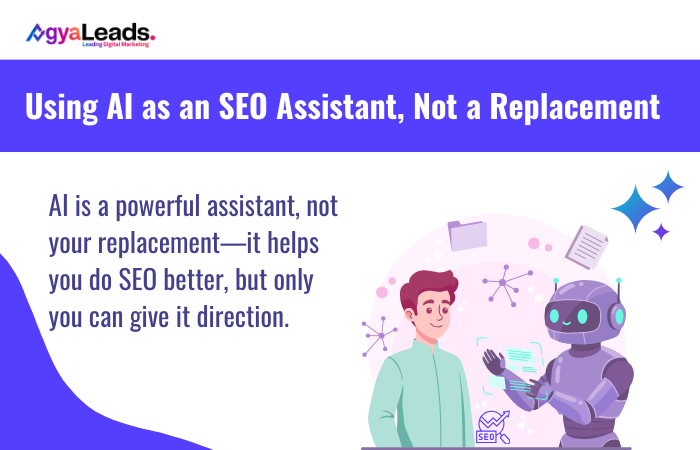
AI can analyze search trends, competitor content, and keyword variations faster than any human. It can surface LSI keywords, semantic phrases, and related queries that strengthen topical relevance. However, deciding what truly matters to your audience still requires human insight.
For example, AI may suggest multiple keyword variations for a topic like AI SEO tools. A human understands which variation fits beginners, which suits agencies, and which aligns with a long-term content strategy. This balance is what makes AI-driven SEO effective instead of risky.
Search Intent Is the Core of AI-Assisted SEO
Search intent is the foundation of modern SEO. AI is extremely helpful in identifying intent patterns, but humans must interpret and apply them correctly.
When someone searches for a keyword, they are not just typing words. They are looking for clarity, solutions, or reassurance.
AI tools can scan top-ranking pages and highlight whether the intent is informational, commercial, or comparative. But crafting content that genuinely satisfies that intent is still a human task.
For example, if the search query revolves around AI content creation for SEO, users are often worried about quality, penalties, and effectiveness. A helpful article acknowledges those concerns, explains the reality, and offers reassurance backed by practical insight.
That emotional understanding cannot come from AI alone, but AI can help structure the content around those needs.
MORE like THIS:
SEO vs SEM vs SMM: What’s the Difference?
How to Build a Digital Marketing Strategy From Scratch?
Content Creation with AI Still Needs a Human Voice
Content writing is where most SEO mistakes happen with AI. Many people publish AI-generated articles without editing, assuming search engines will accept them. In 2026, this approach consistently fails.
AI-generated content often lacks depth. It explains topics broadly but avoids specifics. It sounds correct but not experienced. This is why human editing is essential.
When AI helps draft content, the human role is to add clarity, examples, and relevance.
For instance, if AI writes a paragraph about improving SEO workflows, a human can add how AI reduced research time or helped identify content gaps. These small touches transform generic text into useful content that readers trust.
SEO content today must feel written for people first. AI supports that goal only when guided properly.
AI and On-Page SEO in 2026
On-page SEO has become more about meaning than mechanics. AI helps optimize content for semantic search by suggesting related phrases, improving internal consistency, and highlighting missing subtopics.
AI tools can analyze whether a page fully covers a topic or only scratches the surface. They can identify opportunities to expand explanations or clarify confusing sections. However, the final decision on what to add or remove must be human-led.
A good example is heading structure. AI may suggest multiple headings based on keyword data, but humans understand which headings improve readability and which ones feel forced.
On-page SEO works best when content flows naturally while still covering all relevant search terms.
Technical SEO Becomes Easier with AI Support
Technical SEO is one area where AI truly shines. It can process large datasets, identify patterns, and highlight issues much faster than manual methods.
AI-powered SEO tools help identify crawl issues, slow-loading pages, indexing problems, and internal linking gaps. This saves time and allows SEO professionals to focus on strategy instead of repetitive checks.
Still, AI only highlights problems. Humans decide priorities. A slow page that brings conversions matters more than a slow page no one visits. This judgment comes from experience, not automation.
When AI and human analysis work together, technical SEO becomes more efficient and more impactful.
AI, Content Updates, and SEO Longevity
SEO in 2026 is not about publishing once and forgetting. Content needs regular updates to stay relevant. AI helps identify which pages are losing visibility and why.
AI tools can compare older content with newer ranking pages and highlight missing sections or outdated information. This makes content updates faster and more focused.
However, updating content is not about adding words. It is about improving usefulness. Humans decide what readers need today compared to last year. AI simply points out where attention is required.
This approach keeps content fresh, accurate, and aligned with current search expectations.
Why Human Judgment Still Drives Rankings
Despite all advancements, SEO remains a human-driven discipline. AI does not understand brand voice, audience emotion, or long-term goals. It cannot decide what makes content trustworthy or relatable.
Search engines aim to serve users, not reward automation. Content that feels helpful, clear, and honest performs better regardless of how it was created. This is why human review is non-negotiable in AI-assisted SEO.
Successful SEO in 2026 depends on restraint. Using AI everywhere without control leads to inconsistency and risk. Using AI thoughtfully leads to clarity and scale.
The Sustainable Way to Use AI for SEO
The most sustainable SEO strategies treat AI as an assistant that enhances productivity without sacrificing quality.
AI accelerates research, analysis, and optimization. Humans handle storytelling, insight, and decision-making.
This collaboration allows websites to publish better content, not just more content. It improves relevance without losing authenticity. Over time, this builds authority, trust, and stable rankings.
AI alone cannot build SEO success. Humans alone struggle to scale. Together, they create balance.
Final Thoughts
SEO in 2026 is not about choosing between AI and humans. It is about using both correctly. AI supports research, structure, and optimization. Humans provide meaning, experience, and judgment.
This no-nonsense guide to using AI for SEO that actually works in 2026 shows that rankings come from clarity, intent, and usefulness.
When AI is treated as an assistant rather than a shortcut, SEO becomes more effective and more sustainable.
If you as an seo expert focus on search intent, human-edited content, semantic relevance, and thoughtful optimization, AI becomes a powerful ally.
Used wisely, it strengthens SEO strategies, improves efficiency, and helps content stay relevant in a constantly evolving search landscape.
FAQs
Can AI really help with SEO in 2026?
Yes, AI can support SEO in 2026 by helping with keyword research, content optimization, technical audits, and analyzing search intent. However, human input is still needed to ensure content is helpful, trustworthy, and aligned with Google’s quality standards.
What is the best way to use AI for SEO?
The best way to use AI for SEO is as a support tool. Let AI handle research, outline creation, or data analysis, while you focus on writing with experience, adding insights, and aligning content with user intent.
Does Google penalize AI-generated content?
Google doesn’t penalize content just because it’s AI-generated. However, it must be high-quality, useful, and original. AI for SEO works best when humans guide, edit, and enhance the final content to meet user needs.
How can I combine AI and human input for SEO content?
Use AI to generate outlines or find topic ideas, then write and edit using your experience. Add real examples, address user questions, and make the content easy to read. This human-AI collaboration improves rankings and user engagement.
How does AI help with search intent in SEO?
AI analyzes top-ranking pages and search patterns to identify what users expect. It helps match content with search intent—whether informational, transactional, or navigational—so your page answers the right questions and ranks higher.